InTech Aerospace Has a Great Story to Tell: Meet the People Making Old Aircraft Feel New
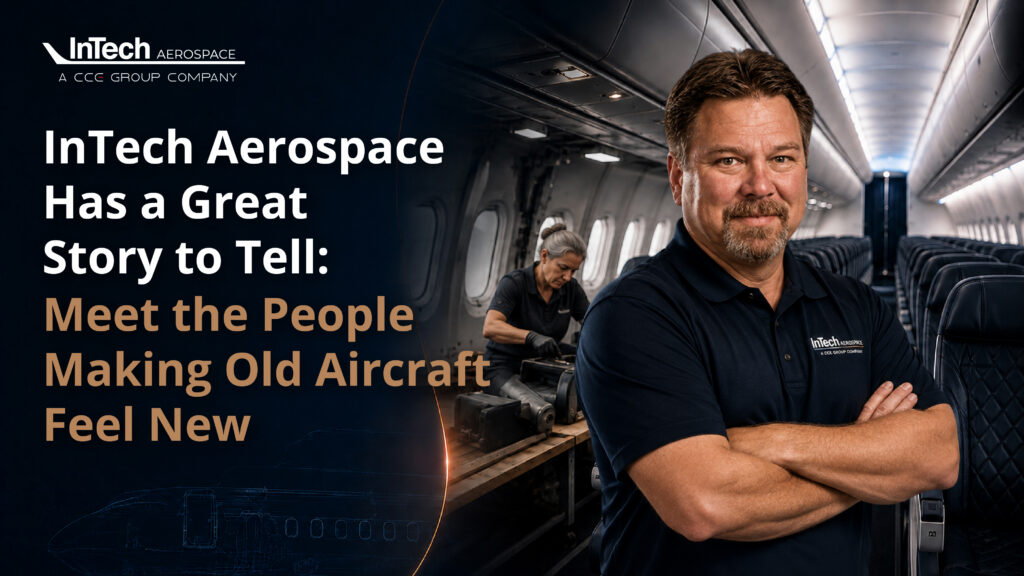
By Scott Mowery, President of InTech Aerospace
When you take your seat on an aircraft, it should feel as though you are the first person ever to sit there.
The aircraft may have entered service five years ago or fifty. The seat may have carried thousands of passengers. The tray table may have opened and closed more times than anyone could count. None of that should be visible when the next passenger takes their place.
A well-maintained cabin should feel fresh, comfortable, and ready, no matter how old the aircraft is. At InTech Aerospace, our job is to help return aircraft cabin interiors to that standard.
Our craftspeople and technical specialists make that possible. They restore the parts passengers see and touch, from seats and tray tables to panels, carpets, plastics, galleys, and overhead bins.
The materials selected for aircraft seats are cut, stitched, fitted, and finished by hand, with care given to every seam, pattern, contour, and final fit. Modern technology gives our people better tools and more consistent processes. Their judgment, craftsmanship, and pride determine the result.
That combination of craftsmanship, technology, and care has guided InTech for more than 35 years. It is also the foundation for our next stage of growth as part of CCE Group.
The people behind the cabin
Headquartered in Houston, InTech Aerospace is a U.S. Federal Aviation Administration (FAA) Part 145 repair station specializing in aircraft cabin interiors. The certification sets the standards for how our work is performed, inspected, documented, and returned to service. We provide cabin-interior maintenance, repair, overhaul, and refurbishment services primarily for commercial airlines, while also supporting government and military programs, business aviation, and VIP aircraft.
There is a good chance you have already experienced our work. Many of the parts passengers see, touch, sit on, open, and close pass through the hands of our team.
The real story is the people who restore those parts. Our seamstresses and upholsterers understand how materials behave and how a finished seat cover should look and fit. Our technicians know how components age, how failures occur, and what can be repaired safely and properly. Together with our engineering, quality, and planning teams, they turn that experience into reliable work.
That experience guides how we use technology. CNC cutting, digital pattern development, mold production, and thermoforming improve speed and consistency, while skilled people still decide whether the result is right.
Quality comes first. We repair intelligently, preserve what can be saved, and keep more capability in-house. That allows us to deliver work to a high standard while remaining highly competitive on price.
Why cabin MRO matters now more than ever
Aircraft are staying in service for longer because airlines can no longer assume replacement aircraft will arrive on schedule. British Airways expects delays from Boeing and Airbus to affect its fleet plans for another four to five years, and it is still waiting for Boeing 777X aircraft originally due in 2022. Delays like these force airlines to keep existing aircraft flying and find additional capacity elsewhere.
Some of those aircraft have already been in service for decades, while replacement parts may be expensive, obsolete, or difficult to source. Maintaining cabin interiors, therefore, becomes a practical part of fleet planning, extending the useful life of the aircraft without allowing the passenger experience to feel old.
The scale of that challenge is growing. On July 23, 2026, Flightradar24 tracked 153,359 commercial flights worldwide, the busiest single day in its records. Every flight adds more wear to the cabin and another reason to repair well rather than replace unnecessarily.
Passengers may never notice a clean carpet, but they will register if their shoes stick to it. They notice when the seat feels worn, the tray table does not work, or the seatback entertainment screen will not play a movie. Those details shape comfort, perceived value for money, and the passenger’s opinion of the airline. For the operator, they also affect maintenance schedules, cost, and aircraft availability.
Those cabin issues often have to be resolved while the aircraft is already out of service for major scheduled maintenance. During these heavy checks, seats, panels, bins, and other interior components may be removed for inspection, repair, or refurbishment. If they are not returned when the aircraft is ready to be reassembled, the aircraft can remain grounded even though the rest of the maintenance work is complete. That can mean lost flights and revenue, replacement-aircraft costs, disrupted crew and maintenance schedules, passenger rebooking, and damage to the airline’s reputation. One late panel may be a small repair. If it delays reassembly, cancels a flight, or keeps the aircraft grounded into the next day, the knock-on cost can run into six figures.
Given the importance of this work to keeping aircraft in service, it is worth restating the three promises we make to every customer. They are not new. They are the reasons customers choose InTech and stay with us: quality repairs, reliable delivery, and solutions that make financial sense. Each can be measured in practical terms.
- Performance You Can Measure
Quality begins with the discipline of an FAA-certified Part 145 repair station. The work has to meet the technical requirement, fit the aircraft, look right, perform as expected, and leave our facility with the correct documentation and release.
Delivery dates matter because customers build maintenance schedules, staffing plans, budgets, and aircraft availability around them. For eligible single repair orders, InTech offers a 30-day turnaround commitment. For agreed ship-set programs, we plan the work around the same aircraft’s heavy-check schedule. In one regional aircraft program, our team completed a complete interior ship set in 12 days, keeping the aircraft aligned with its planned check.
Cost efficiency has to be measured across the whole maintenance event. The cheapest quote can become the most expensive choice in the hangar when it leads to rework, expedited freight, a missed maintenance window, or more aircraft downtime.
- Long-Term Solutions
Repair is the core of what we do. Replacement is sometimes necessary, but it should not be the automatic answer when an approved repair can safely return a component to service.
Our teams develop approved repairs and, where permitted, fabricate replacement components when parts are slow, expensive, obsolete, or unavailable. The damaged component is often only one part of the problem. The customer may also be dealing with an aircraft schedule, a late maintenance finding, or a cabin standard that has to be maintained across a mixed fleet.
Sometimes the job is one damaged panel, tray table, or seat component. That first order quickly shows a customer how we communicate, solve problems, and handle a commitment.
At the other end of the scale, an airline or MRO may send us a complete ship set during a heavy check. Seats, panels, bins, and other interior components have to move through inspection, repair, quality, logistics, and installation planning in time to meet the aircraft. The scale may change, but the work still deserves the same care and accountability.
- Trust Earned Every Time
InTech has built its reputation by doing good work, dealing honestly with customers, and staying responsive when a job becomes difficult. Much of the MRO market operates through non-exclusive agreements, so the next order is never guaranteed. Loyalty has to be earned each time.
Houston has a direct and practical business culture. I was raised to believe that your word is your bond, and that a handshake is a promise that can carry as much weight as a contract. In complex aviation environments, that trust still has to survive the paperwork, inspections, technical approvals, and delivery dates. That means giving customers an honest answer at the beginning, communicating early when something changes, and taking responsibility for the path forward.
The same principle applies inside InTech. People do their best work when they have the right tools, clear expectations, and the chance to build a career they can be proud of. We can run a disciplined aviation business, hold high standards, and still treat people well.
Growth through CCE Group
In April 2026, CCE Group acquired InTech Aerospace, adding our cabin MRO and refurbishment expertise to its growing aerospace ecosystem.
The timing makes sense. Aircraft are staying in service for longer, supply chains remain under pressure, and customers need practical support across the full life of the equipment they operate. CCE Group sees MRO as an important part of meeting that need.
In just over a year, CCE Group has expanded from two companies to five. Trip & Co, Icebridge, and InTech Aerospace have joined Driessen and AviusULD as the group builds a connected aerospace ecosystem around specialist leaders. Together, the five companies provide expertise across cabin catering equipment, cooling, aircraft containers and pallets, cargo protection, smart technology, and cabin MRO.
For customers, that creates more ways to solve connected problems. Each company remains focused on its own specialist field, while the wider group can bring together complementary expertise, introduce customers to additional capabilities, and support more of the equipment lifecycle through one trusted ecosystem.
For InTech, the value is practical. CCE Group gives us greater reach, stronger industry relationships, and the backing to expand our capabilities and serve more airlines and MRO partners. In return, InTech brings hands-on knowledge of how cabin components perform after years of real airline use, helping the wider group think more deeply about durability, repairability, and total cost of ownership.
Houston is the foundation, but it will not be our only base. InTech is moving ahead with ambitious regional expansion plans, with two new locations already in development. Bringing our capabilities closer to customers will reduce transport time, lower schedule risk, and make it easier to support larger aircraft-interior programs at scale.
At CCE Group, the goal is to unite exceptional niche leaders into a global aerospace platform force while preserving what makes each unique. InTech will continue to focus on the craftsmanship, responsiveness, and technical judgment that built its reputation, now supported by a much larger platform for growth.
Making the work visible
For most of our history, InTech has focused on the work itself.
We are now making that expertise easier to see as we reach more airlines and MRO partners through CCE Group.
That means sharing more of the people, craftsmanship, repair knowledge, and practical problem-solving behind the result. Airlines and MRO partners should understand the problems we can solve before they become more expensive or disruptive.
The passenger may never know our name. They should feel the result the moment they take their seat.
